
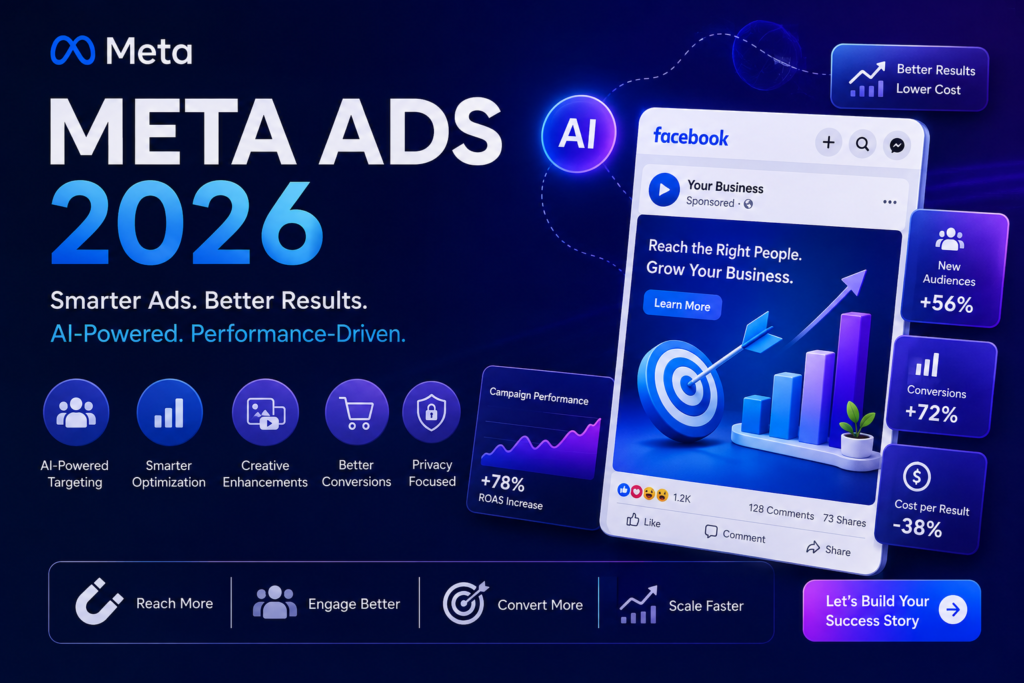
Meta Ads have evolved more in the last two years. Meta is now heavily powered by Artificial Intelligence. Instead of manually selecting every audience, placement, and optimization setting, advertisers are expected to provide high-quality creative assets and let Meta’s AI optimize delivery.
1. AI Is Now the Heart of Meta Advertising
Meta’s AI now helps with:
- Audience targeting
- Budget allocation
- Creative testing
- Ad placements
- Performance optimization
2. Creative Has Become More Important Than Targeting
Images, videos, headlines, copy, and even the first few seconds of a Reel provide signals that help Meta find the right audience. Industry observers increasingly describe this as “creative becoming targeting.”
Create multiple variations:
- Different hooks
- Different headlines
- Different thumbnails
- Different customer pain points
Instead of testing one ad, test many creative angles.
3. Advantage+ Is Expanding Everywhere
Meta continues expanding Advantage+ features.
These include:
- Advantage+ Audience
- Advantage+ Placements
- Advantage+ Budget Optimization
- Advantage+ Shopping Campaigns
- AI Creative Enhancements
Meta now offers more AI-powered creative tools that can:
- Generate image backgrounds
- Extend images
- Create different text versions
- Translate creatives
- Generate product-focused carousel variations
- Create voiceovers and localized creative elements
This helps businesses create more ad variations with less manual effort.
5. Better Reporting & Attribution
Meta has updated parts of its reporting and attribution to better distinguish engagement from link-click behavior, giving advertisers a clearer picture of what actually drives conversions.
This makes it easier to understand:
- Which ads generate real traffic
- Which campaigns drive purchases
- Which creatives deserve more budget
Meta has updated parts of its reporting and attribution to better distinguish engagement from link-click behavior, giving advertisers a clearer picture of what actually drives conversions.
This makes it easier to understand:
- Which ads generate real traffic
- Which campaigns drive purchases
- Which creatives deserve more budget
6. New Audience Guidance Features
Some advertisers are seeing a new “Describe your audience” field within Advantage+ Audience.
Instead of relying only on interests, you can provide a natural-language description of your ideal customer to help guide Meta’s AI. The feature is being rolled out gradually.
7. Short Videos Continue to Dominate
Reels remain one of the highest-engagement placements across Meta platforms.
Successful advertisers are investing more in:
- Vertical videos
- Customer testimonials
- Before & after transformations
- Product demonstrations
- UGC-style content
8. First-Party Data Matters More
Privacy changes continue to reduce the effectiveness of relying only on third-party signals.
Businesses should focus on collecting:
- Website leads
- CRM data
- Customer lists
- Pixel events
- Conversions API (CAPI) events
These help Meta’s AI optimize more accurately.
9. Automation Doesn’t Mean “Set and Forget”
Many advertisers think AI means campaigns run themselves.
That’s not true.
You still need to:
- Refresh creatives regularly
- Test new offers
- Improve landing pages
- Monitor lead quality
- Scale winning campaigns carefully
AI improves delivery—but strategy is still your job.
10. What Still Matters in 2026
Even with all the automation, the fundamentals haven’t changed.
Winning advertisers still focus on:
- Great offers
- High-quality creatives
- Strong copywriting
- Fast websites
- Good customer experience
- Continuous testing